Are your eyes deceiving you? Fact-checking and misinformation in the age of AI
A master's thesis that delves into the gap between political misinformation and the use of fact-checking in Colombia. An analysis of our ability to navigate post-truth and the challenges posed by artificial intelligence in building a critical citizenry.
PORTAFOLIO
The Challenge: Navigating Post-Truth in Electoral Contexts
In Colombia's current information ecosystem, social media has become the main source of news, coexisting with low trust in traditional media, which barely reaches 34%. This combination creates fertile ground for the spread of misinformation, especially during election periods, when emotional manipulation tactics and cognitive biases undermine democratic debate.
My master's research arose from a fundamental question: How are fact-checking platforms really contributing to mitigating this phenomenon in the country?
Research: A mixed approach to a complex reality
To obtain a comprehensive view, I designed a study that combined quantitative rigor with qualitative depth:
Quantitative Component: I surveyed 121 citizens to identify their information habits and perceptions about the veracity of the content they consume.
Qualitative Component: I conducted in-depth interviews with three key experts: José Sarmiento (director of Colombiacheck), Paola Hincapié (expert in digital audiences), and Daniel Duque (former councilman and government professor).
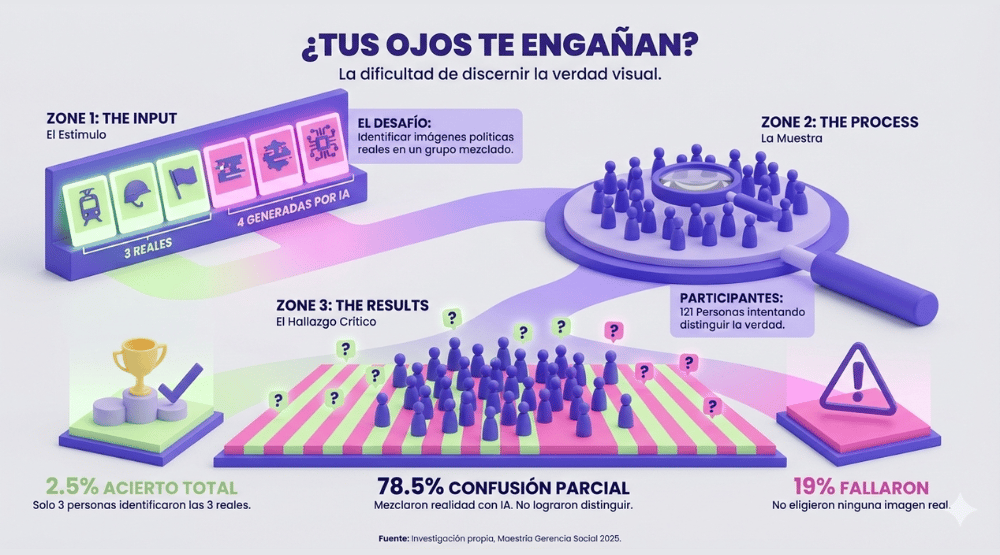
Visual Experiment: I included an identification exercise to assess people's ability to distinguish between real images and scenes generated entirely with artificial intelligence.
Critical Findings: The gap between perception and action
The results revealed a worrying reality about our informational resilience:
High perception, low verification: Although 78.5% of people perceive political misinformation to be frequent, only 11.6% regularly use specialized fact-checking platforms.
Vulnerability to AI: The visual exercise was revealing: only 2.5% of participants correctly identified all the real images. More than 75% showed partial confusion, mixing reality with synthetic content.
Ideology does not discriminate: Disinformation affects all sectors. The study showed that, regardless of political orientation, people are susceptible to validating fake news when it reinforces their prior beliefs (confirmation bias).
Towards the Solution: Beyond Data, Literacy
The research concludes that fact-checking is an important tool but insufficient if it remains limited to technical refutation. True transformation requires:
Media and political literacy: Strengthening critical thinking from basic education onwards to understand algorithmic logic.
Slow-cooking narratives: Promoting journalism that provides context and does not just compete for clicks.
Regulation and transparency: Demanding algorithmic clarity from global platforms to protect the integrity of public information.